TECHNIQUE
Toe, Camber and Caster: The Ultimate Setup Guide to Wheel Alignment
Camber, toe and caster define how your tires meet the asphalt. Understanding them separates a setup that works from one that only looks like it does.
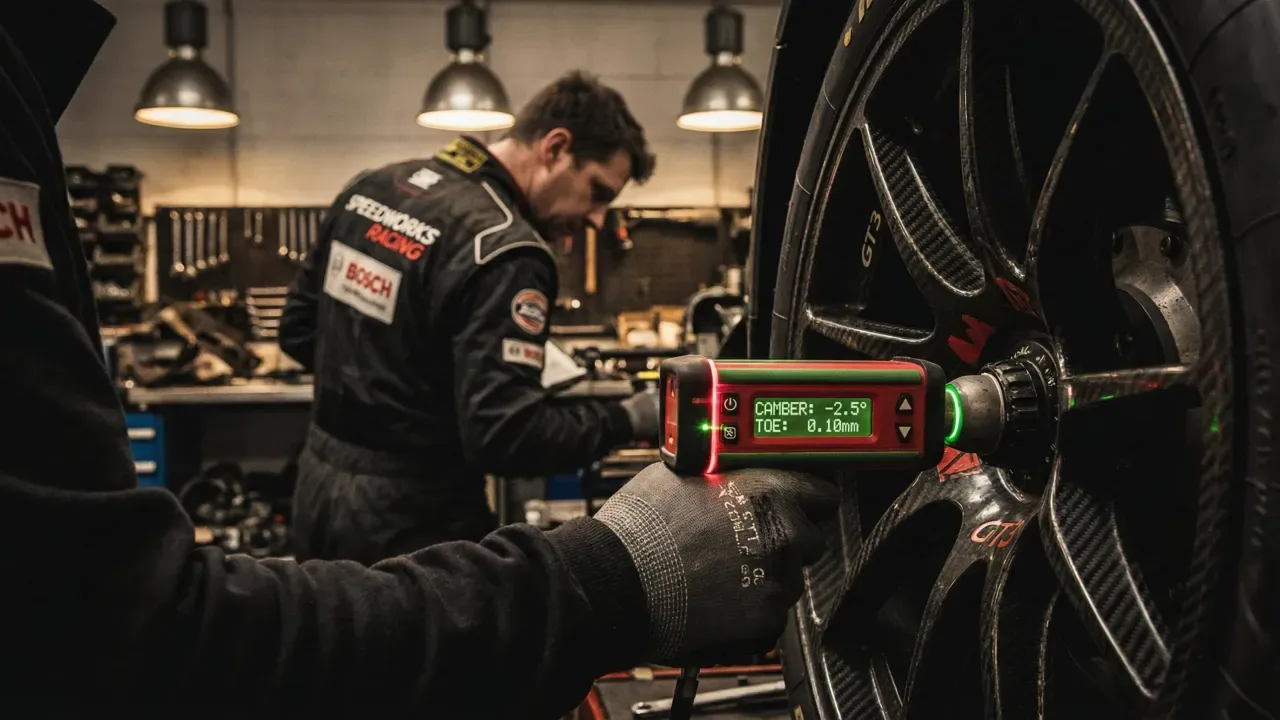
Wheel alignment is one of the most technical parts of a setup and also one of the most misunderstood. Many drivers adjust camber without understanding what it does, or ignore toe because they "don't know what it is". This guide explains the three fundamental alignment settings in a clear, practical way.
Camber: the tilt of the wheel
Camber is the angle at which the wheel tilts relative to vertical. Negative camber means the top of the wheel leans in towards the car. Positive camber (rare in racing) means the top leans outwards.
How much camber to run in Assetto Corsa
Typical values in AC for GT cars are between -2.5° and -3.5° at the front, and between -1.5° and -2.5° at the rear. More negative camber improves cornering grip but increases wear and can make the car nervous on the straights. Less camber gives more straight-line stability but can make the car feel "floaty" in fast corners.
Toe: which way the wheels point
Toe is the angle of the wheels relative to the car's centerline, seen from above. Toe-in means the wheels point slightly inwards. Toe-out means they point outwards.
- Front toe-in: more straight-line stability, less response on corner entry
- Front toe-out: more agility on corner entry, less straight-line stability
- Rear toe-in: more overall stability, less oversteer in fast corners
- Rear toe-out: more rotation, more oversteer (rarely used)
Caster: the steering axis angle
Caster is the angle of the steering axis relative to vertical. It's the least known of the three and the one adjusted least often in sim racing, but it has a significant effect on how the car behaves. More positive caster increases straight-line stability and steering self-centering, but it can make the steering heavier.
How the three settings interact
Alignment can't be optimized one setting at a time — the three interact with each other. A camber change affects how toe works. A caster change affects how effective camber is in corners. That's why professional setups are developed as a system, not as individual adjustments.
Perfect alignment doesn't exist in the abstract — it exists in relation to a specific car, a specific track and a specific driving style.
Motorsport engineering
Signs that your alignment needs adjusting
- The car feels "floaty" in fast corners → more front negative camber
- Excessive wear on the inner edge of the tire → too much negative camber
- The car doesn't turn in well on corner entry → try more front toe-out
- The car is unstable on fast straights → more front or rear toe-in
- The wheel doesn't return to center on its own → check the caster